

Relationship extraction from unstructured species descriptions using TaxonNERD and LLaMA2 - 7B
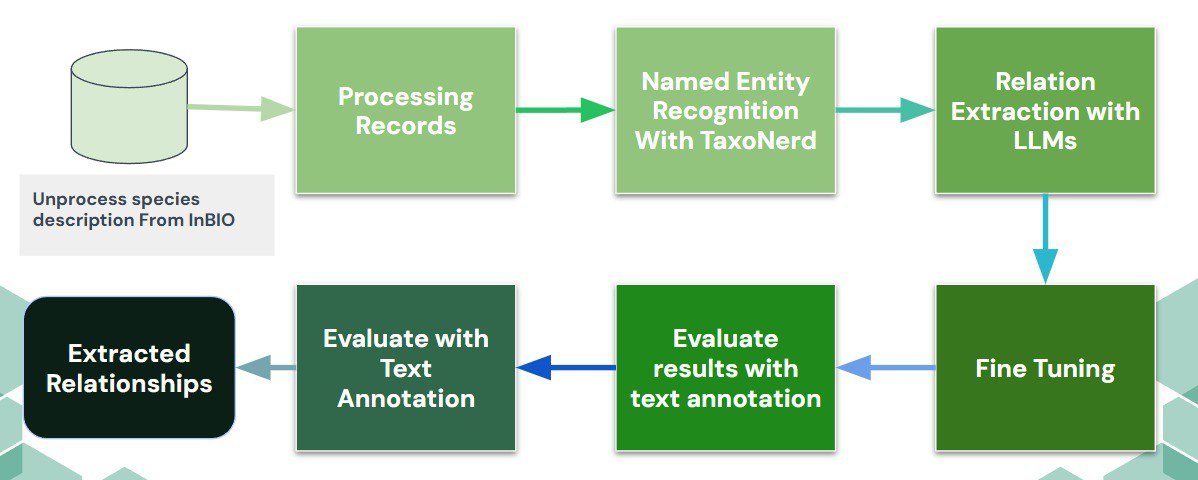
This project explores how to extract structured information on feeding relationships between animal species from originally unorganized textual descriptions. The project combines ecological ontologies with advanced Natural Language Processing (NLP) methods, using specialized tools such as TaxoNERD for entity recognition, and the LLaMA2-7b model for extracting specific relationships, particularly predator-prey dynamics. The dataset used comes from the National Institute of Biodiversity (INBio), with descriptions in Spanish and English about feeding habits and ecological behaviors.
The methodology consisted of preprocessing INBio texts to identify taxonomic entities and feeding-related terms using TaxoNERD. Subsequently, the LLaMA2-7b model was employed to extract concrete relationships, thus generating a structured dataset where the diet of each studied species is clearly detailed. The obtained results were manually reviewed through a custom text annotation tool developed specifically for this project, ensuring the quality and accuracy of the generated information.
The evaluation showed promising results, with a precision of 68%, recall of 73%, and F1-score of 71%, particularly highlighting the model's ability to detect key relationships in species descriptions. As a next step, the model will be further refined to improve its accuracy and broaden its scope to other ecological relationships, thereby strengthening its usefulness for future biodiversity research and environmental conservation efforts.
Ecosystem Simulator Using Large Language Models (LLM).
This project seeks to develop an ecosystem simulator that models the interaction between multiple agents, resources, and the environment, using Deep Reinforcement Learning combined with advanced natural language models (LLM). Initially, a simplified 2D environment will be implemented using Python's Gym library, where various agents will learn optimal survival strategies through algorithms such as DQN, PPO, and A2C. In addition, advanced reasoning and interaction capabilities will be incorporated through an LLM (such as LLaMA 3), enabling intelligent decision-making, natural communication between agents, and generating understandable explanations of their actions.
Subsequently, the possibility of scaling the simulator to a three-dimensional environment using Minecraft together with the MineRL library will be evaluated, exploring technical feasibility and documenting possible limitations or challenges. During development, several deliverables will be produced, including a complete code repository, technical reports on the architecture and algorithms used, as well as visual demonstrations of agent performance in both environments (2D and 3D).
Finally, this project aims to offer not only a versatile simulation environment rich in biological interactions but also a robust platform to investigate emergent behaviors in multi-agent systems and explore innovative applications of artificial intelligence and natural language processing. The simulator will allow deeper studies of ecological dynamics while facilitating future research on the practical and effective integration between deep reinforcement learning and advanced generative language models.